
Audi Q5 Coolant Leak - Causes & OEM Parts by Generation
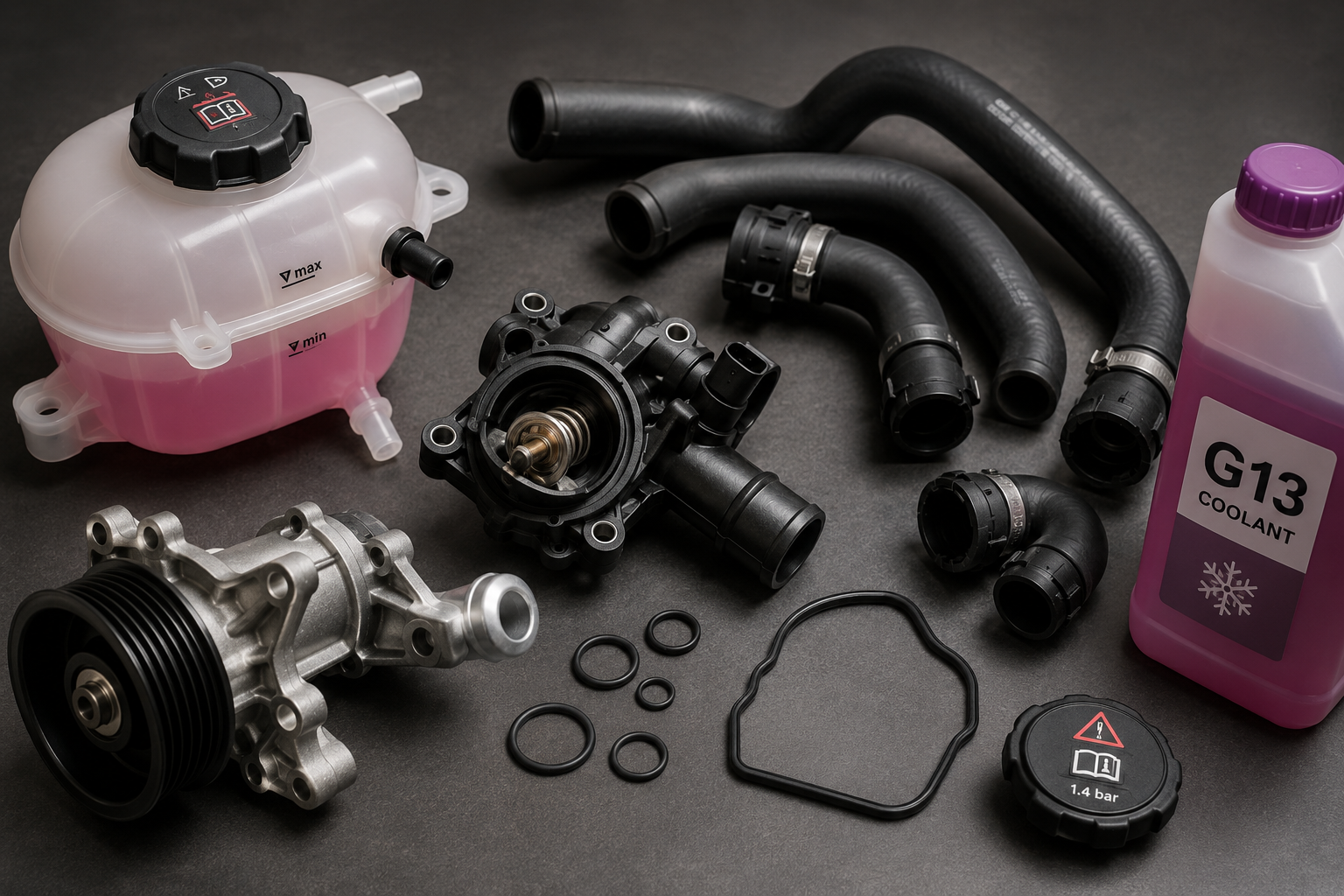
A coolant leak on the Audi Q5 should be fixed as soon as possible. Even a small leak can lead to overheating, especially on the EA888 turbocharged engine. Overheating may cause head gasket failure, which is much more expensive to repair than the original leak. Below, you’ll find the most common coolant leak sources for each Q5 generation, along with OEM part recommendations to help you identify and repair the problem.
AudiOEMParts.com carries genuine OEM coolant system parts for every Q5 generation. Each order is VIN-verified to match your vehicle’s production date.
Why Audi Q5 Coolant Leaks Are Easy to Miss Early
The Q5 uses a pressurized, closed-loop cooling system that holds about 6 to 7 liters of coolant, depending on the engine. Small leaks or cracks may not leave a visible puddle, since coolant can evaporate from hot engine parts before it drips.
Early signs of a coolant leak on the Q5 include a sweet antifreeze smell after driving, a low coolant warning on the MMI display, or a slow drop in coolant level between services with no clear source. For Q5s over 80,000 miles, check the coolant level at each fuel stop. This quick check can help prevent overheating and breakdowns.
Most Common Coolant Leak Points on the 8R Q5 - 2009 to 2017
Thermostat Housing
On the 8R Q5 with the 2.0T engine, the thermostat housing is the most common source of coolant leaks. This plastic housing bolts to the aluminum engine block and can crack or lose its seal after years of heat cycles. When it fails, coolant often collects at the front of the engine on the passenger side, sometimes dripping from underneath with no clear source above.
The OEM thermostat housing for the 8R 2.0T comes as a complete assembly with the thermostat included. Replace both together. Do not reuse the old thermostat in a new housing.
Upper and Lower Coolant Hoses
The 8R Q5 uses reinforced rubber coolant hoses with molded ends that attach to the thermostat housing, radiator, and other connections. After 80,000 to 100,000 miles, the rubber can harden and develop small cracks at the clamp points where stress is highest.
These cracks are often hidden unless you squeeze the hose while it is cold. Replace any hose that feels stiff, has dried coolant residue at the ends, or shows visible cracks. If you are replacing the thermostat housing, check and replace the connected hoses at the same time to avoid repeat leaks.
Coolant Expansion Tank
The plastic coolant expansion tank on the 8R Q5 often develops hairline cracks as the vehicle ages. Cracks usually form near the sensor port or along the molded seam after years of pressure and heat. This causes a slow leak that leaves dried coolant on the outside of the tank, but usually no puddle underneath.
If you see a light pink or green film on the outside of the expansion tank, the tank is likely leaking. Some OEM replacement tanks include the coolant level sensor, but not all. Check what is included before ordering so you do not buy the sensor separately if it comes with the tank.
Most Common Coolant Leak Points on the FY Q5 - 2018 to 2024
Thermostat Housing
The second generation FY Q5 updated the cooling system layout but retained a plastic thermostat housing with the same age-related failure pattern seen on the 8R. FY Q5 examples that are now approaching 80,000 to 120,000 miles are entering the window where housing failures are most common. The repair procedure is identical to the 8R, and the same recommendation applies: replace the housing as a complete assembly, including the thermostat.
Rear Engine Coolant Pipe and O-Ring Seals
The FY Q5 uses a coolant distribution pipe along the rear of the engine block, sealed with O-rings at each junction. As these O-rings age, they can harden and start leaking, causing coolant to weep from the back of the engine near the firewall. This leak is hard to spot from above. If your FY Q5 is losing coolant but you do not see a leak at the front, have a shop pressure-test the rear pipe O-ring seals before replacing other parts.
Accessory Belt Driven Water Pump
The FY Q5 uses a belt driven water pump, while the 8R had a chain-driven design. Belt driven pumps often start to fail with bearing noise before the seal leaks. If you hear a rumble or squeal from the front of the engine that changes with RPM, check the water pump first. Bearing failure can cause the belt to slip or break, leading to sudden overheating and coolant loss.
Audi Q5 Coolant Specification - G13 Only
All Audi Q5 models, from the 8R to the FY, require G13 coolant or an aftermarket fluid that meets the G13 spec. G13 is pink or purple and is formulated for aluminum engine blocks.
Never mix G13 with older G12, G11, or green coolant. Mixing types weakens the corrosion protection and can damage plastic housings, O-rings, and hose ends. If your Q5’s coolant is discolored, brown, or unknown, flush the system and refill with G13 before making other repairs.
Replace Related Parts Together on the Q5 Cooling System
When replacing the thermostat housing on the 8R Q5, also replace the coolant hoses. The hoses connect to the housing and are usually the same age. Leaving old hoses on a Q5 with over 90,000 miles often leads to another leak within a year.
Always replace the coolant cap when you install a new expansion tank. The cap holds the system at 1.4 bar pressure. If the cap is worn, it can release pressure too soon and cause coolant loss, even with a new tank.
When replacing the water pump on the FY Q5, inspect the serpentine belt and belt tensioner at the same time. These parts are accessed together, and the tensioner spring often wears out around the same mileage as the pump bearings.
Frequently Asked Questions - Audi Q5 Coolant Leak
Can I drive my Q5 with a small coolant leak?
A small coolant leak can get worse quickly, especially during highway driving when the system is under pressure. Driving a Q5 with a leak risks overheating and possible head gasket damage on the EA888 engine. Head gasket repairs cost much more than fixing the original leak. Fix coolant leaks as soon as you notice them.
How do I find a Q5 coolant leak with no visible puddle?
A cooling system pressure test is the best way to find a hidden leak. Use a pressure tester cap on the expansion tank to pressurize the system. If the pressure drops over 15 minutes, there is an active leak. This test can reveal small cracks or O-ring leaks that do not leave a puddle.
Does the OEM thermostat housing include the thermostat on the Q5?
For most Q5 models, the OEM thermostat housing comes with the thermostat included. Always check your VIN when ordering to confirm what is included for your vehicle.
What coolant does the Audi Q5 use?
Every Q5 needs G13 coolant, either as a 50/50 premix with distilled water or mixed from concentrate. Do not use green conventional coolant or mix different coolant types in the Q5.
How much coolant does the Audi Q5 hold?
The 8R Q5 2.0T holds about 6.3 liters of coolant. The FY Q5 holds about 7 liters. Actual capacity can vary by engine and options, so check your owner’s manual for your specific model.
Shop Genuine OEM Audi Q5 Cooling System Parts at AudiOEMParts.com
AudiOEMParts.com offers genuine OEM thermostat housings, coolant hoses, expansion tanks, water pumps, O-ring kits, and G13 coolant for every Q5 generation. All orders are VIN-verified for your production date. For help with part selection, email [email protected] with your VIN and mileage before ordering.